MBBS in Bangladesh costs Indian students roughly ₹28–50 lakh for the full course, spans a 5-year academic programme plus a 1-year mandatory internship, and requires a qualifying NEET-UG score even though Bangladesh itself does not use NEET for admission. Graduates must clear India's FMGE or NExT licensing exam before they can practice medicine in the country.
Key Facts at a Glance
- Duration: 5-year MBBS + 1-year internship
- Total cost: ₹28–50 lakh (tuition, hostel, food, documentation)
- NEET: Not needed for Bangladesh admission, but mandatory for Indian students under DGME rules
- Recognition: NMC (India), WHO, BMDC (Bangladesh), ECFMG
- Medium of instruction: English
- Post-graduation requirement: FMGE or NExT to practice in India
Why Indian Students Choose Bangladesh for MBBS
Every year, well over 2 million students appear for NEET-UG in India, but the country has fewer than 1.1 lakh MBBS seats across government and private colleges combined. That gap pushes a large number of qualified but unplaced students to look abroad. Bangladesh has emerged as one of the preferred options because of its lower total cost compared to private colleges in India, English-medium teaching, geographic proximity to eastern and northeastern India, and a cultural and dietary environment that Indian students adapt to quickly.
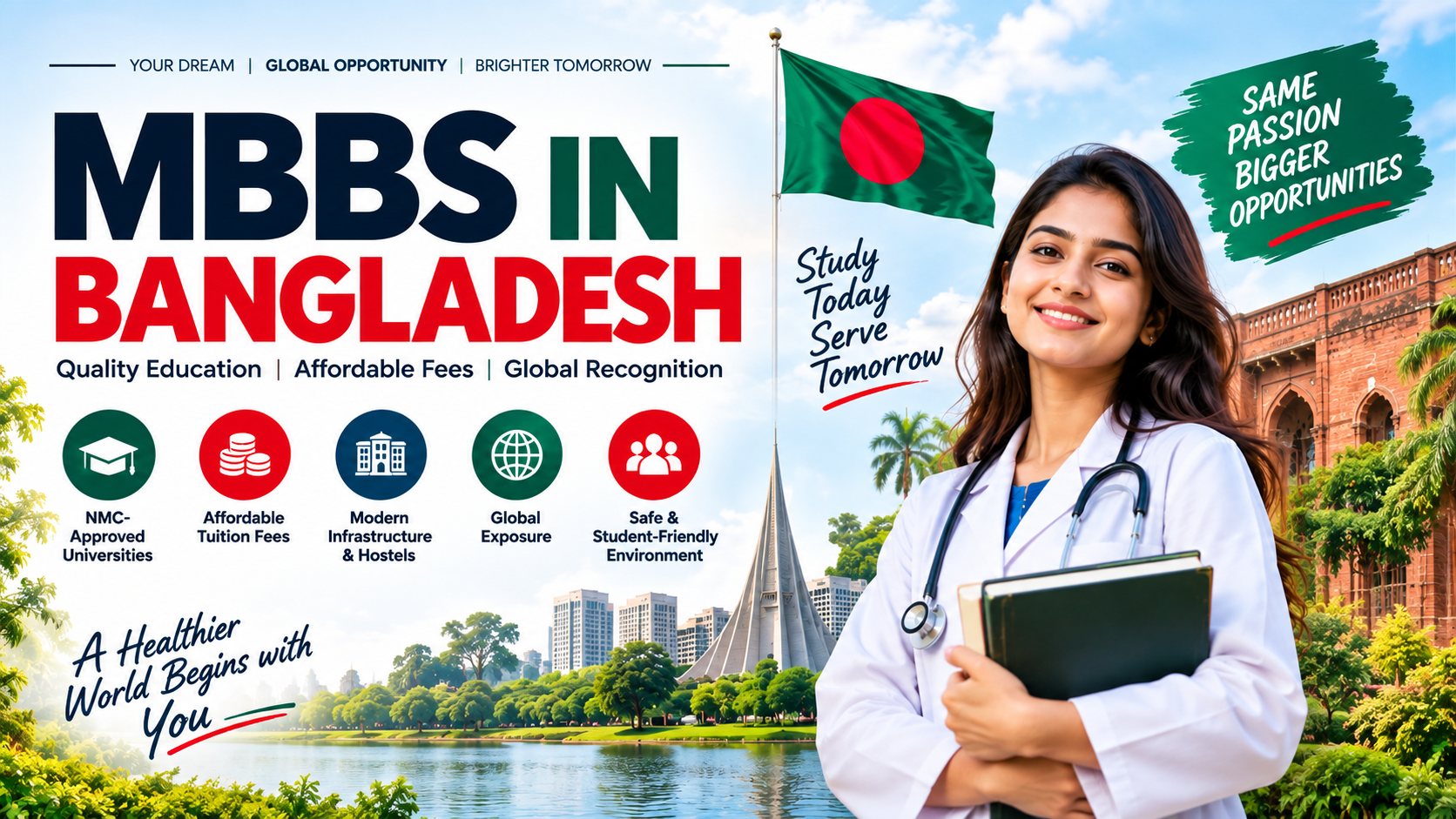
Colleges in Bangladesh are recognised by the National Medical Commission (NMC) of India, the World Health Organization (WHO), the Bangladesh Medical and Dental Council (BMDC), and in several cases the Educational Commission for Foreign Medical Graduates (ECFMG) — making the degree usable both in India and internationally, subject to the destination country's own licensing exams.
Eligibility Criteria for Indian Students (2026–27)
Under the latest Directorate General of Medical Education (DGME) norms applicable to Indian applicants, students need:
- 10+2 with Physics, Chemistry and Biology (PCB) from a recognised board
- Minimum 60% aggregate in PCB for general category; 55% for SC/ST/OBC candidates
- A qualifying NEET-UG score — 50th percentile for general category, 40th percentile for reserved categories
- Minimum age of 17 years, completed by 31 December of the admission year
Bangladeshi universities themselves do not require NEET for admission, but Indian regulations make a valid NEET-UG score compulsory for Indian nationals seeking admission abroad and for later medical registration in India.
Is NEET Compulsory for MBBS in Bangladesh?
Yes — for Indian students specifically. Bangladesh's own admission process does not use NEET, but Indian students must hold a qualifying NEET-UG score to apply through the DGME's foreign-student pathway, and the same NEET qualification is later required to sit India's FMGE or NExT licensing exam after graduation. Without a valid NEET score, an Indian graduate of a Bangladeshi medical college cannot register to practice in India, regardless of how they were admitted.
Fee Structure: What Does MBBS in Bangladesh Actually Cost?
Total costs vary by college, city and hostel arrangement, but most reputable sources place the complete 5–6 year package — tuition, hostel, food, documentation and miscellaneous fees — between ₹28 lakh and ₹50 lakh. Government-affiliated medical colleges tend to sit at the lower end of this range, while premium private colleges in Dhaka and Chittagong can cost more. This remains significantly cheaper than most private medical colleges in India, where total costs can run considerably higher for a similar or lower quality of clinical exposure.
Living costs on top of tuition are relatively modest, with monthly hostel, food and personal expenses commonly estimated at around ₹10,000–15,000 (roughly $120–180).
Top NMC-Approved Medical Colleges in Bangladesh
Bangladesh has more than 20 NMC-approved medical colleges and universities accepting Indian students. Well-known institutions include:
- Dhaka Medical College
- Chittagong Medical College
- Sir Salimullah Medical College, Dhaka
- Rajshahi Medical College
- Bangabandhu Sheikh Mujib Medical University
- Holy Family Red Crescent Medical College, Dhaka
- Eastern Medical College, Comilla
- International Medical College, Gazipur
Before shortlisting a college, students should verify current NMC and BMDC approval status, the affiliated teaching hospital, hostel facilities, and the fee structure directly with the institution or a registered consultancy — approvals and fee schedules are revised periodically.
Step-by-Step Admission Process
- 1. Qualify NEET-UG with the required percentile for your category.
- 2. Shortlist colleges based on NMC/BMDC recognition, fees, and teaching hospital quality.
- 3. Apply through the DGME's foreign-student process and the chosen university's admission office.
- 4. Submit documents — 10th and 12th mark sheets, NEET scorecard, passport, photographs, and required certificates.
- 5. Receive the offer/visa invitation letter from the university.
- 6. Pay first-year tuition and apply for a Bangladesh student visa.
- 7. Travel and complete enrolment formalities on campus.
Documents Required
- Class 10 and Class 12 mark sheets and certificates
- NEET-UG scorecard
- Valid passport
- Passport-size photographs
- Migration and transfer certificates
- Medical fitness certificate
Recognition and Career Pathway After Graduation
An MBBS from an NMC-approved Bangladeshi college is recognised for practice in India, but graduates must first clear the Foreign Medical Graduate Examination (FMGE) or its successor, the National Exit Test (NExT), and complete registration with the NMC. Graduates who wish to practise outside India can also pursue recognition through bodies such as the WHO or ECFMG, depending on the destination country's requirements. Students should treat the licensing exam as a core part of the journey — completing an MBBS abroad is not, by itself, a licence to practise in India.
Life in Bangladesh for Indian Students
Indian students generally report an easy cultural adjustment — similar climate, familiar food, and Bengali/Hindi-adjacent language exposure in many cities, alongside English-medium classes. Most colleges offer on-campus or nearby hostel accommodation.
It's worth noting candidly that Bangladesh saw political unrest in July–August 2024 that led to the temporary evacuation of thousands of Indian students; most returned once conditions stabilised, and classes have been reported running normally through 2026. Prospective students and families should factor in this history when planning and stay updated through official advisories before and during their course.
Frequently Asked Questions
See the FAQ section below.
Sources
See the Sources section below for full attribution.