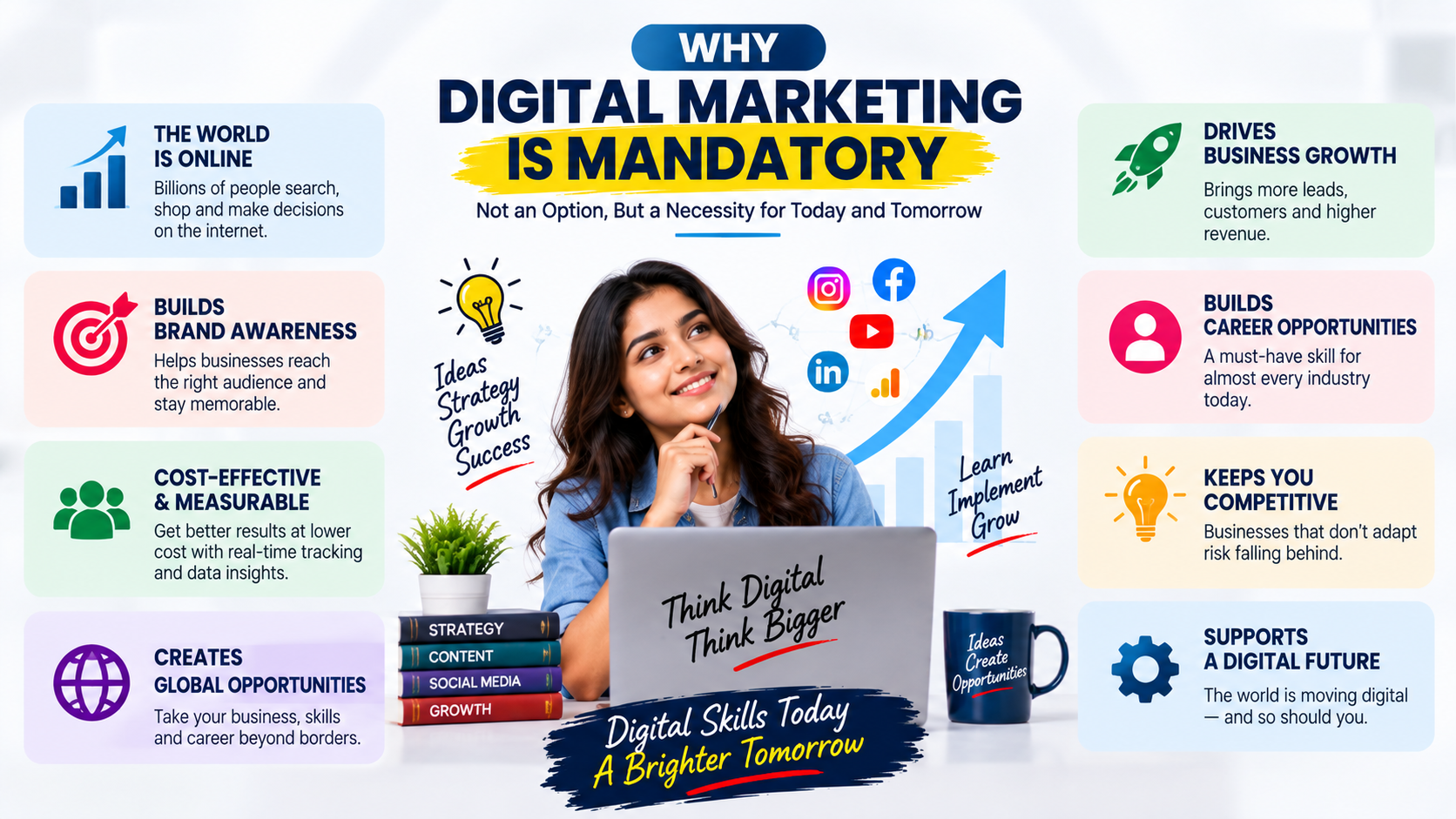
Digital marketing is mandatory for business growth because customers already research, compare and judge businesses online before ever making contact, and digital channels deliver measurable returns — averaging around $5 for every $1 spent — that traditional advertising cannot match. Businesses without a digital presence aren't neutral in the market; they're invisible to it.
Key Facts at a Glance
- Average ROI: ~$5 earned for every $1 spent on digital marketing
- Email marketing ROI: $36–42 for every $1 spent — the highest of any channel
- PPC ROI: ~200% ($2 for every $1 spent) via Google Ads and Facebook Ads
- Budget shift: 72% of overall marketing budgets now go to digital channels
- SMB reliance: 58% of small businesses depend on digital marketing to connect with customers
The Shift Has Already Happened — You're Just Deciding Whether to Join It
Roughly 72% of overall marketing budgets now go toward digital channels, and the split between digital and traditional media is close to permanent — 63% of businesses have increased their digital marketing budgets in recent years, and most small businesses plan to keep raising spend rather than cut it. The global digital advertising market is on track to cross $780–800 billion in 2026.
This isn't a trend still building momentum. It's a market that has already restructured itself around digital-first customer behaviour. Businesses that haven't restructured their marketing along with it aren't "behind schedule" — they're competing with one hand tied behind their back.
1. Your Customers Are Already Searching, Scrolling, and Comparing Online
Before a customer ever calls you, walks into your store, or requests a quote, they've almost certainly searched for your business or your competitors on Google, checked reviews and ratings, looked at your website or social media profile, and compared you against at least one other option.
If your business has no meaningful digital presence at that moment, you don't lose the sale — you're never even considered. A Google Business Profile alone drives a large share of nearby customers to visit a store within 24 hours of searching. Local SEO and digital visibility aren't marketing extras; they're the modern equivalent of having your shop sign visible from the street.
2. Digital Marketing Delivers Measurable, Provable ROI — Traditional Marketing Doesn't
This is the point that matters most to business owners watching every rupee: digital marketing is the only major marketing channel where you can measure return down to the individual rupee spent.
- Businesses typically earn around $5 for every $1 spent on digital marketing overall.
- Email marketing alone regularly returns $36–42 for every $1 spent — among the highest ROI of any marketing channel.
- Pay-per-click (PPC) advertising returns roughly $2 for every $1 spent, a 200% ROI, with Google Ads and Facebook Ads posting the strongest results.
- Nearly half of marketers (49%) rank organic search (SEO) as their single best-performing channel for ROI.
Compare that to a newspaper ad, a hoarding, or a radio spot — you can estimate reach, but you can rarely prove which customer walked through your door because of it. Digital marketing removes that guesswork.
3. It Puts Small Businesses on a Level Playing Field With Big Ones
Traditional advertising rewarded businesses with the biggest budgets — TV slots, billboards, and print space went to whoever could pay the most. Digital marketing rewards relevance and targeting, not just budget size.
A local clinic, a boutique, or a small consultancy can run a precisely targeted campaign — by location, age, interest, or search intent — for a fraction of what a mass-media campaign would cost, and reach exactly the people most likely to buy. That's why 58% of small businesses now rely on digital marketing specifically to connect with customers.
4. Customers Expect It — And Judge You by Its Absence
A weak or missing digital presence doesn't read as neutral to a modern customer — it reads as a red flag. A business with no website, no reviews, an outdated social profile, or no way to be found on a Google search increasingly looks unprofessional or even untrustworthy, regardless of how good the underlying product or service actually is.
Your digital presence isn't just where you advertise anymore; it's part of how customers evaluate whether you're a real, credible business worth trusting with their money.
5. Digital Marketing Scales — Traditional Marketing Doesn't
A billboard shows the same message to everyone who drives past it, whether they're a potential customer or not. Digital marketing does the opposite: it lets a business run different messages to different audience segments simultaneously, test which one performs best, and shift budget toward what's working — often within days, not months.
- Businesses using a multi-channel digital strategy see meaningfully better results than those relying on a single channel.
- Retargeting customers who've already shown interest can lift conversions significantly compared to cold audiences.
- Marketing automation is now used by half of all businesses to manage leads, follow-ups, and personalisation at scale.
6. The Competitive Cost of Not Doing It Is Rising Every Year
Here's the uncomfortable part: while digital marketing has gotten more measurable and more affordable per lead, the cost of having no digital strategy has gotten more expensive — not in direct spend, but in lost opportunity.
Despite the ROI data being publicly available, a large share of small business owners remain unsure whether their current marketing is even working, and many spend well below what's recommended (industry guidance suggests 7–8% of revenue on marketing). The businesses that close that gap aren't just marketing more; they're actively pulling ahead of competitors who are standing still.
Every quarter a business delays building a real digital presence, its competitors are collecting more reviews, ranking higher in search, building larger retargeting audiences, and training their ad algorithms with more data — all of which compound over time.
7. AI Has Made Digital Marketing More Efficient, Not Less Necessary
Some business owners assume AI and automation will make marketing "handle itself." What's actually happening is different: AI is removing the manual grunt work — segmentation, reporting, ad copy variations, basic content drafts — while making strategy, brand voice, and campaign judgment more important, not less. Businesses that treat this as a reason to disengage from marketing altogether are the ones most likely to fall behind; the ones that use it to double down on quality and consistency are pulling further ahead.
The Bottom Line
Digital marketing isn't "mandatory" in a compliance sense — no one is forcing you to do it. It's mandatory in the same sense that having a working website is mandatory, or accepting digital payments is mandatory: the market has moved, and standing still is a decision with consequences. Customers are already searching, comparing, and forming judgments about your business online whether you participate in that conversation or not. The only real choice left is whether you shape that conversation with a deliberate, measured strategy — or leave it entirely to competitors who already have.
Frequently Asked Questions
See the FAQ section below.
Sources
See the Sources section below for full attribution.