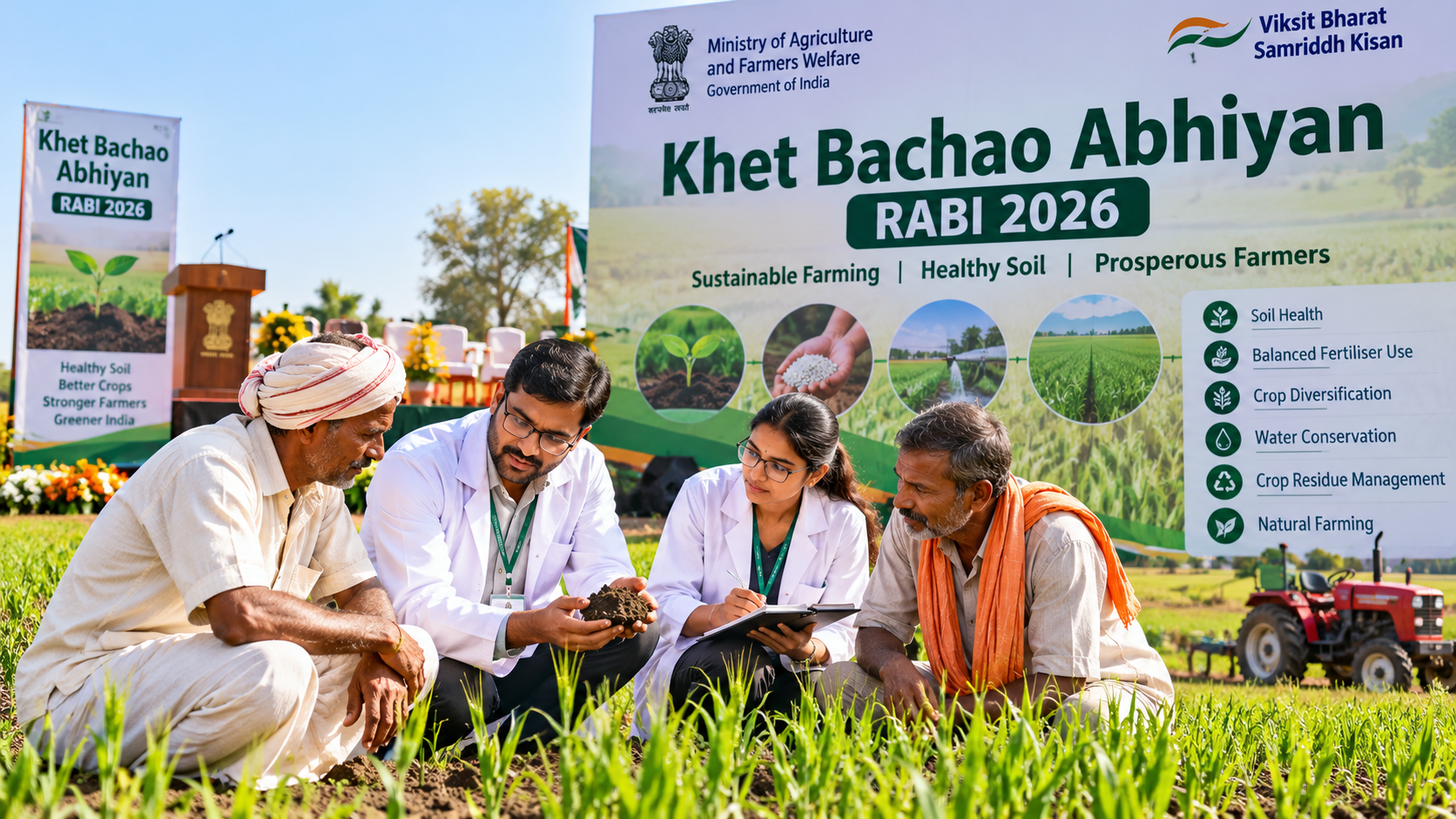
The Centre's Khet Bachao Abhiyan–Rabi 2026 is set to bring agricultural awareness activities to farming communities across India, with a focus on protecting soil health, improving the use of farm inputs and encouraging sustainable cultivation practices. The campaign was scheduled to begin in Karnal, Haryana, on 22 October and will continue until 30 November 2026.
The Ministry of Agriculture and Farmers Welfare announced the initiative as part of its efforts to encourage farmers to make informed decisions about fertilisers, crop selection, water use and crop residue management. Union Agriculture and Farmers Welfare Minister Shivraj Singh Chouhan was scheduled to launch the nationwide campaign from Karnal.
According to the ministry's announcement, the campaign will involve agricultural departments, scientists, Krishi Vigyan Kendras (KVKs), research institutions and other agricultural organisations. Activities are planned at state, district, block and Gram Panchayat levels.
What Is Khet Bachao Abhiyan–Rabi 2026?
Khet Bachao Abhiyan–Rabi 2026 is a nationwide agricultural outreach initiative designed to raise awareness about sustainable farming and the responsible use of agricultural resources.
Its central focus is to encourage farming practices that maintain soil fertility, improve water-use efficiency and help farmers make better-informed decisions about agricultural inputs. The campaign also aims to promote crop diversification and the productive use of fields left fallow after paddy harvesting.
Rather than focusing on a single crop or farming technique, the initiative brings together several agricultural priorities, including soil health management, natural farming, crop residue management, integrated pest management and climate-resilient agriculture.
Why Is the Campaign Being Conducted During the Rabi Season?
The Rabi season is an important period in India's agricultural calendar. Crops such as wheat, mustard, chickpea and other pulses are cultivated during this season, depending on local climate, irrigation availability and farming conditions.
Decisions made around sowing time can influence the use of fertilisers, irrigation, seeds and other agricultural inputs. The campaign aims to improve awareness of these decisions by bringing agricultural experts and extension services closer to farmers.
For farmers whose paddy fields become available after harvesting, the campaign also highlights the potential for using suitable crops in the following season. The appropriate crop depends on soil conditions, available water, local climate, seed availability and other practical considerations.
Major Objectives of Khet Bachao Abhiyan 2026
1. Promote balanced fertiliser use
One of the campaign's main objectives is to encourage the balanced and judicious use of fertilisers and other agricultural inputs based on soil testing.
Soil testing can help farmers understand the nutrient status of their fields and make more informed fertiliser decisions. Applying inputs according to crop needs and locally appropriate recommendations can help avoid unnecessary applications and support long-term soil management.
The campaign also includes awareness about biological products and the appropriate use of different agricultural inputs. Farmers should follow recommendations from qualified agricultural experts rather than assume that a single fertiliser or product is suitable for every field.
2. Encourage crop diversification
The initiative will promote crop diversification through oilseed, pulse and horticulture missions. Diversification can help farmers evaluate alternatives to growing the same crop repeatedly, depending on local conditions and market opportunities.
However, changing crops requires careful planning. Farmers need to consider seed availability, soil suitability, irrigation, production costs, local demand and the availability of buyers before making a decision.
3. Improve the use of fields after paddy harvesting
The campaign will encourage the effective utilisation of fields left fallow after paddy harvesting, including suitable rice-fallow cultivation opportunities.
In regions where conditions permit, growing suitable pulses or other crops after paddy can improve land utilisation. The choice must be based on local soil moisture, water availability, sowing windows and advice from agricultural specialists.
4. Improve crop residue management
Crop residue management is another important focus. After harvesting, farmers must decide how to manage leftover plant material without creating avoidable environmental or operational problems.
The campaign aims to promote appropriate residue management practices and awareness of improved agricultural technologies. Suitable approaches depend on the crop, machinery availability, local conditions and the recommendations of agricultural experts.
5. Promote natural and resource-efficient farming
The campaign will include awareness and training related to natural farming and the appropriate use of organic and bio-based agricultural products.
It also emphasises water conservation, rainwater harvesting, groundwater recharge and efficient use of agricultural resources. These practices are intended to encourage farming systems that use resources more carefully and support long-term agricultural sustainability.
Water Conservation and Climate-Resilient Agriculture
Water availability is an important consideration in agricultural planning. The campaign aims to promote improved water-use efficiency and encourage practices that help conserve natural resources.
Its stated priorities include rainwater harvesting, groundwater recharge, integrated farming systems and climate-resilient agriculture. The initiative also includes awareness about improved technologies and farm mechanisation.
The practical benefits of these approaches depend on local implementation, soil and weather conditions, access to equipment and farmers' ability to adopt suitable practices. Agricultural experts and local extension services can help farmers identify options appropriate to their fields.
Campaign to Reach Approximately One Crore Participants
The Ministry of Agriculture and Farmers Welfare has set an outreach target of approximately one crore participants through the Agricultural Technology Management Agency (ATMA) and Indian Council of Agricultural Research (ICAR) networks.
According to the ministry's announcement, 4,150 teams involving Krishi Vigyan Kendras and ATMA are envisaged for the campaign. More than 12,000 scientists and ATMA functionaries are expected to contribute to its activities.
These are planned outreach figures rather than a confirmed count of people already reached. The extent of participation and adoption of the recommended practices will depend on implementation across the participating regions.
How Will Farmers Participate?
The campaign is designed to take agricultural information beyond central announcements and into farming communities.
Planned activities include:
- Farmers' conferences and Kisan Chaupals.
- Training sessions on agricultural practices and resource management.
- Field demonstrations of improved technologies.
- Awareness programmes at state, district, block and Gram Panchayat levels.
- Participation by agricultural scientists and extension personnel.
- Outreach through local-language information materials, radio, Doordarshan and social media.
State Agriculture Departments, KVKs, ICAR institutes, state agricultural universities and ATMA are expected to work together. Farmer Producer Organisations, cooperatives, Self-Help Groups and progressive farmers are also identified as potential participants in the outreach effort.
Farmer IDs, Crop Insurance and Kisan Credit Card Awareness
The campaign also includes awareness-related activities connected with existing farmer support systems.
Farmer ID creation
The initiative will facilitate the creation of Farmer IDs. Farmers should check with the relevant state agriculture department or designated local authority for the applicable registration process and required documents.
Pradhan Mantri Fasal Bima Yojana
The campaign will promote awareness about crop insurance under the Pradhan Mantri Fasal Bima Yojana (PMFBY). Farmers interested in coverage should verify the crops covered, applicable notification, enrolment deadlines, eligibility and premium details for their location and season.
Kisan Credit Card
The campaign also aims to expand awareness and coverage under the Kisan Credit Card (KCC) scheme through saturation efforts. Farmers should approach the relevant bank or authorised institution to check eligibility, documentation and applicable lending conditions.
The campaign's announcement does not mean that every participating farmer will automatically receive a Farmer ID, insurance payment or KCC loan. Each programme continues to have its own requirements and procedures.
Which Organisations Will Implement the Campaign?
The Department of Agriculture and Farmers Welfare will coordinate with state governments, ICAR institutions and other stakeholders to support implementation and monitoring.
Key participating organisations identified in the announcement include:
- State Agriculture Departments.
- Krishi Vigyan Kendras.
- Indian Council of Agricultural Research institutions.
- State Agricultural Universities.
- Agricultural Technology Management Agencies.
- Farmer Producer Organisations, cooperatives and Self-Help Groups.
The use of local institutions is intended to make agricultural information more accessible and encourage interaction between farmers and agricultural specialists.
What Should Farmers Do During the Campaign?
Farmers interested in participating should look for announcements from their local agriculture department, KVK, block agriculture office or Gram Panchayat. These channels can provide information about the dates, locations and subjects of local training sessions and demonstrations.
Farmers can make these activities more useful by preparing questions about their own fields, including:
- Whether a recent soil test is available and what it indicates.
- Which fertilisers and quantities are appropriate for their crop and soil.
- Whether a suitable crop can be cultivated after paddy harvesting.
- How to manage crop residues using locally available resources.
- Which water-conservation practices are practical for their land.
- Whether they meet the requirements for Farmer ID registration, crop insurance or KCC-related services.
Recommendations should be tailored to the crop, soil, location and local conditions. Farmers should confirm technical advice with qualified agricultural experts before making major changes to cultivation practices.
What to Watch for as the Campaign Progresses
The announcement sets out the campaign's objectives, proposed outreach and participating institutions. Its practical impact will become clearer as local programmes are conducted and information becomes available about participation and implementation.
Important developments to watch include the number and reach of local training sessions, farmers' access to soil-testing advice, awareness of crop insurance and credit facilities, and the adoption of suitable crop diversification and resource-management practices.
The campaign's stated target of approximately one crore participants provides a measure of planned outreach. Actual participation and measurable agricultural outcomes should be assessed using subsequent official updates rather than assumed from the announcement alone.
Frequently Asked Questions
What is Khet Bachao Abhiyan–Rabi 2026?
It is a nationwide agricultural awareness campaign of the Ministry of Agriculture and Farmers Welfare focused on soil health, balanced fertiliser use, crop diversification and sustainable farming practices.
When did Khet Bachao Abhiyan–Rabi 2026 begin?
The campaign was scheduled to launch on 22 October 2026 from Karnal, Haryana, and continue until 30 November 2026.
Who is launching the campaign?
Union Agriculture and Farmers Welfare Minister Shivraj Singh Chouhan was scheduled to launch the campaign from Karnal, Haryana.
What is the main objective of the campaign?
Its main objective is to promote sustainable agriculture through better soil health management, balanced fertiliser use, efficient resource utilisation and appropriate farming practices.
How many participants does the campaign aim to reach?
The announced outreach target is approximately one crore participants through ATMA and ICAR networks.
Will the campaign cover villages and Gram Panchayats?
Yes. Planned activities include awareness programmes, farmers' meetings, training sessions and field demonstrations at state, district, block and Gram Panchayat levels.
Will farmers receive free fertilisers or financial assistance automatically?
The campaign announcement focuses on awareness, training and agricultural practices. It does not establish automatic entitlement to free fertilisers or direct financial assistance. Farmers should check individual schemes and their eligibility requirements.
How can farmers find campaign activities in their area?
Farmers can contact their local Agriculture Department, Krishi Vigyan Kendra or block agriculture office for information about local programmes and demonstrations.
Conclusion
Khet Bachao Abhiyan–Rabi 2026 is a nationwide effort to promote better soil management, balanced agricultural inputs, crop diversification, water conservation and sustainable farming. Its activities are planned to involve agricultural departments, research institutions, extension workers and farming communities across India.
The campaign is scheduled to continue through 30 November 2026. Its practical value will depend on how effectively the planned activities reach farmers and help them apply appropriate recommendations to their fields.
Farmers should follow official announcements from their local agriculture authorities and seek advice suited to their crops, soil and water conditions. Further updates on implementation and participation should be checked against official government releases.
Official source: Press Information Bureau, Ministry of Agriculture and Farmers Welfare — Khet Bachao Abhiyan–Rabi 2026.