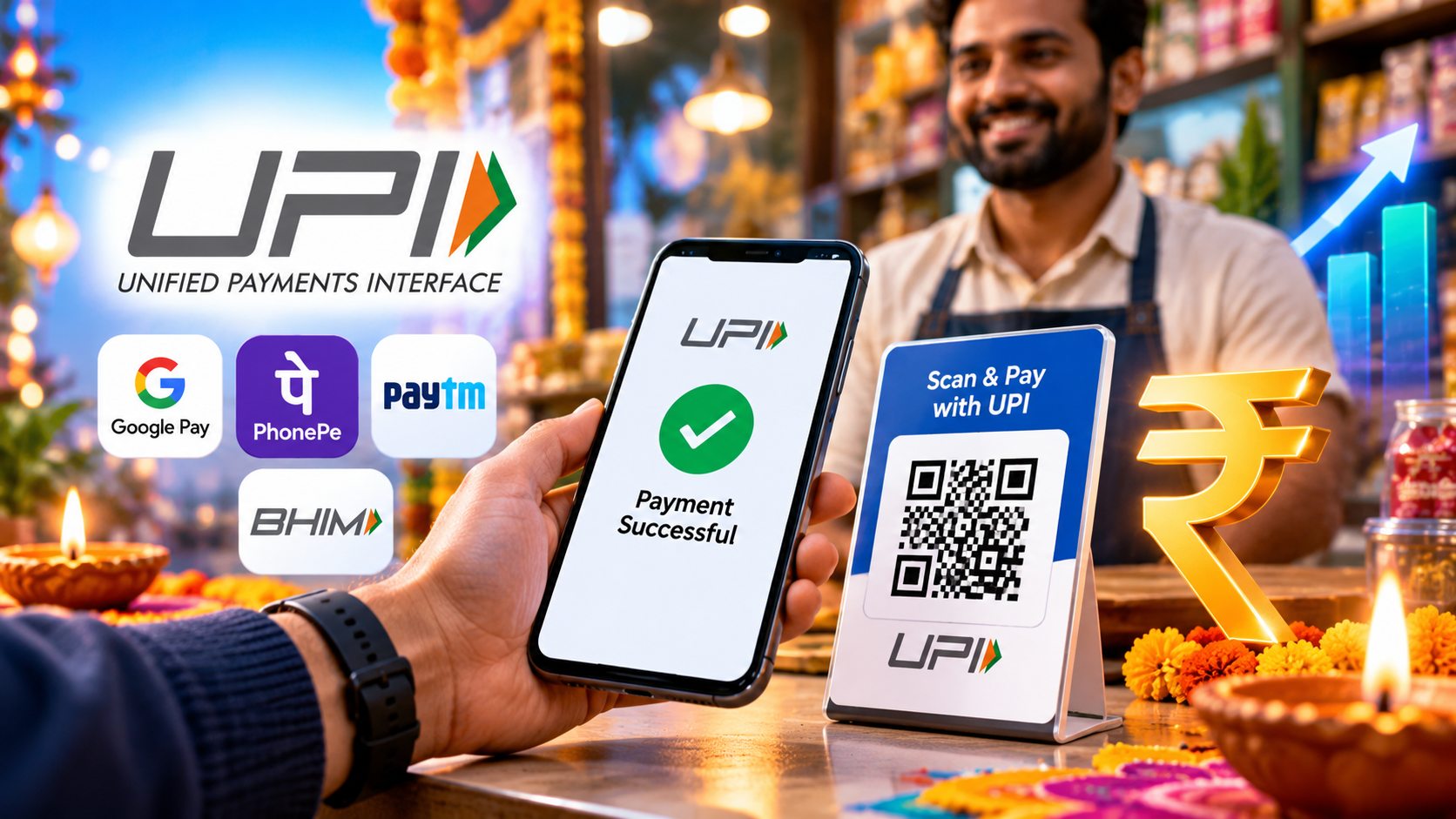
UPI users and businesses in India have received an important update after the National Payments Corporation of India (NPCI) deferred the planned introduction of a Merchant Discount Rate (MDR) on certain UPI merchant transactions until after Diwali 2026. The rollout had originally been scheduled for October 15, 2026, but the revised implementation date will be announced separately.
The announcement matters to shopkeepers, online businesses and payment service providers preparing for the proposed change. For ordinary users, the most important distinction is that the proposed MDR is a fee payable by eligible merchants, not a general charge on sending money to friends or family through UPI.
Latest update: As reported on October 13, 2026, NPCI postponed the planned rollout until after Diwali. Readers should check official NPCI and government announcements for the revised effective date.
UPI Charges After Diwali 2026: What Has Changed?
The proposed MDR framework was scheduled to begin on October 15, 2026. NPCI subsequently decided to defer implementation until immediately after Diwali, with the precise date to be notified separately.
The postponement gives merchants and payment service providers additional time during the festive shopping period. It does not, by itself, mean that the proposed fee structure has been cancelled.
Under the announced framework, an MDR of 0.4% applies to specified person-to-merchant (P2M) UPI transactions above ₹2,000, subject to the applicable cap and exemptions.
Important: Do not assume that the new fee is already active on October 14, 2026. The latest reported decision is to implement it after Diwali on a date that will be announced separately.
Will Google Pay and PhonePe Users Have to Pay UPI Charges?
The proposed MDR is a merchant-side fee on eligible transactions. It is not a general fee for consumers using Google Pay, PhonePe, Paytm or other UPI applications to send money.
Under the announced framework, person-to-person (P2P) transfers remain free regardless of the transfer amount. Specified merchant transactions of ₹2,000 or less and eligible transactions covered by the zero-MDR framework for small merchants also remain exempt.
The Ministry of Finance stated in its September 2026 explanation that approximately 96% of merchant transactions would remain unaffected under the framework announced at that time.
Consumers should still check their bank and payment application's official terms for any separate service or account-related charges. The MDR proposal should not be confused with a general UPI transfer fee.
What Is the Proposed UPI MDR Fee?
MDR stands for Merchant Discount Rate. It is a fee associated with processing an eligible merchant payment and is payable by the merchant under the announced framework.
The proposed structure includes:
- Rate: 0.4% on specified merchant UPI transactions above ₹2,000.
- Cap: A maximum MDR of ₹300 for transactions of ₹75,000 and above.
- Person-to-person transfers: Remain free under the announced framework.
- Eligible small merchants: Remain covered by zero-MDR provisions.
- Implementation date: Deferred until after Diwali 2026, with the revised date to be announced.
These provisions apply to specified categories, not automatically to every UPI transaction. Merchants should confirm the applicable category, exemptions and settlement terms with their acquiring bank or payment provider.
Examples: How Much Could the Proposed Merchant Fee Be?
The following examples illustrate 0.4% of a transaction amount before applying the applicable cap or exemptions. They are illustrative calculations, not confirmation that a particular transaction qualifies for MDR.
| Eligible transaction amount | Illustrative MDR at 0.4% |
|---|---|
| ₹2,500 | ₹10 |
| ₹5,000 | ₹20 |
| ₹10,000 | ₹40 |
| ₹25,000 | ₹100 |
| ₹75,000 | ₹300 |
| ₹1,00,000 | ₹300 maximum under the stated cap |
These examples show the potential merchant-side cost for transactions that qualify under the proposed rules. Exemptions, transaction categories and the final implementation instructions must be checked before calculating an actual fee.
Which UPI Transactions Are Expected to Remain Free?
The announced framework preserves zero-MDR treatment for several categories.
1. Person-to-person transfers
Sending money to family members, friends or another personal account remains free under the announced framework, regardless of the amount transferred.
2. Merchant payments up to ₹2,000
Merchant transactions of ₹2,000 or less remain outside the proposed MDR charge described in the announced framework, subject to the applicable transaction rules.
3. Eligible small merchants
Merchants covered by the designated person-to-person merchant (P2PM) zero-MDR provisions remain exempt. Businesses should confirm their classification and eligibility with their payment provider.
These exemptions are important because the proposed framework is not a blanket charge on every digital payment made in India.
Why Has NPCI Postponed the MDR Rollout?
The decision was announced during the festive shopping period, when consumers and businesses typically make more purchases and payments. NPCI said implementation would take place immediately after Diwali on a date to be notified separately.
The delay gives payment providers and merchants additional time to prepare for the revised framework. It also means businesses should avoid changing their payment policies based solely on the original October 15 date.
The postponement is a timing change. Readers should wait for the official revised date and implementation instructions before assuming the framework has been cancelled or that every merchant will be charged in the same way.
What Should Shopkeepers and Online Businesses Do?
Businesses accepting UPI should use the postponement period to understand the proposed framework and prepare for the final instructions.
- Contact your acquiring bank or payment service provider to confirm whether your merchant category is eligible for MDR.
- Check whether your business qualifies for zero-MDR treatment under the applicable small-merchant provisions.
- Review settlement reports and merchant agreements for the final fee schedule.
- Monitor NPCI announcements for the revised effective date.
- Do not add a separate customer surcharge based on assumptions about the proposed MDR. Follow the applicable official rules.
Online businesses should also review payment gateway notifications and updated terms before changing checkout prices or payment methods.
Can Merchants Pass the MDR Fee to Customers?
The government has stated that merchants should not pass the announced MDR cost on to customers as a separate charge. The framework is designed around a merchant-side processing fee, not a general consumer UPI fee.
Customers who believe they are being charged an unauthorised UPI surcharge should request clarification from the merchant and check the applicable guidance from their bank or payment provider.
For the final implementation details, refer to the official government FAQ and subsequent NPCI instructions.
UPI MDR After Diwali: What Happens Next?
The key outstanding detail is the revised effective date. NPCI's reported decision moves implementation from October 15 to immediately after Diwali, but the new date is to be announced separately.
Until the revised instructions are published, merchants should avoid assuming that every payment category is affected or that the proposed framework has been withdrawn. Consumers can continue to distinguish ordinary P2P transfers from eligible merchant transactions.
PulseNex Updates will need to update this article when an official implementation date or material change is announced. Readers should consult the official sources below for the latest position.
Conclusion
The planned UPI MDR rollout has been deferred until after Diwali 2026, with NPCI expected to announce a revised effective date separately. The proposed 0.4% fee applies to specified merchant transactions above ₹2,000, subject to the stated cap and exemptions.
For consumers, the key point is that the proposal does not introduce a general fee on ordinary person-to-person UPI transfers. For merchants, the next step is to verify eligibility, understand the final settlement rules and follow the official implementation date when it is announced.
Check the official government and NPCI updates before making decisions about customer payments or business settlement policies.