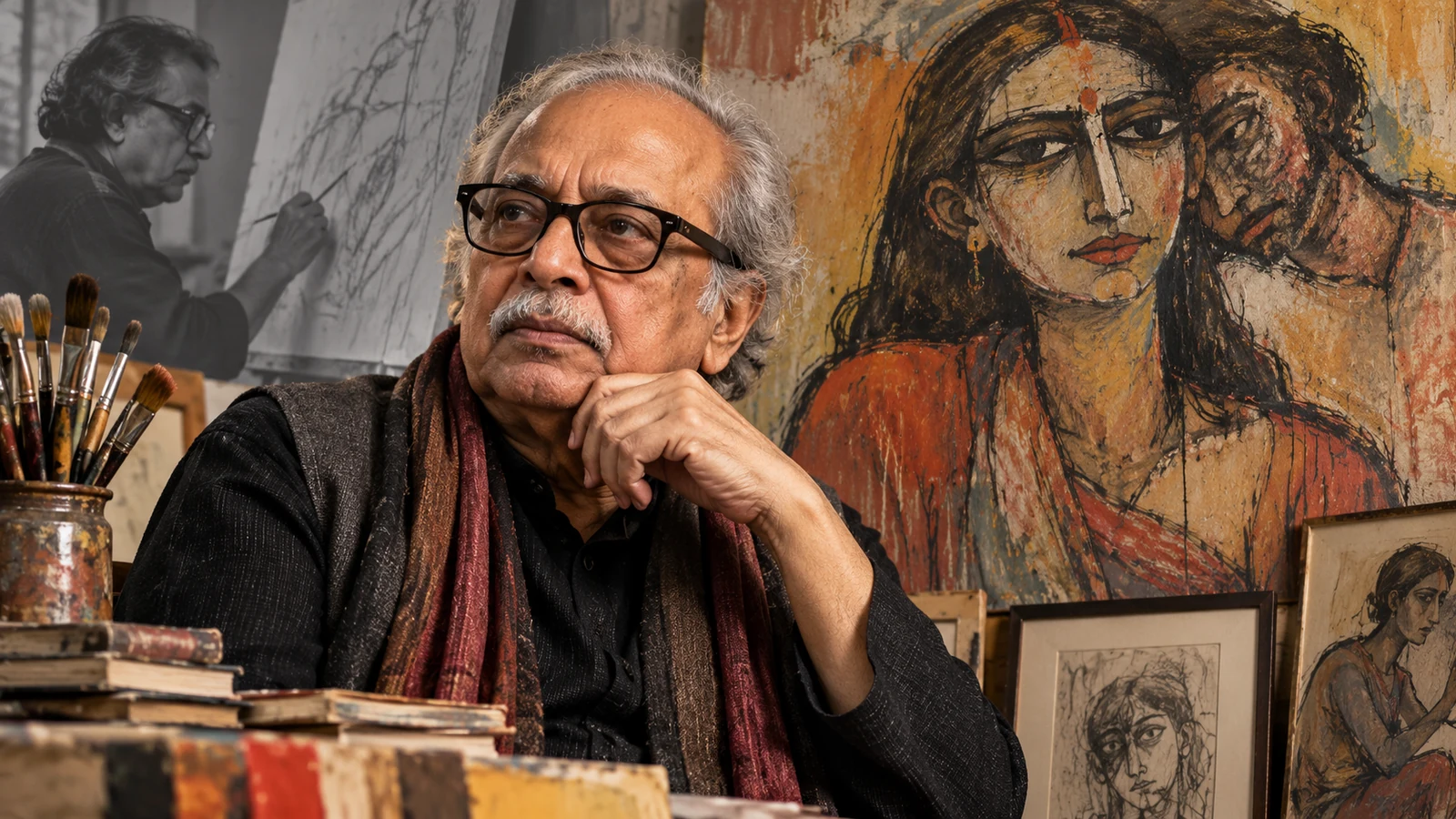
KOLKATA: Renowned Indian painter Jogen Chowdhury died in Kolkata on October 25, 2026, at the age of 87, following a prolonged illness. His death marks a significant loss for India's art community and the cultural landscape of West Bengal.
Chowdhury was widely admired for his distinctive artistic style, expressive human figures and powerful use of lines and cross-hatching. Over several decades, he developed a visual language that explored human emotions, social realities, displacement and the complexities of everyday life.
Beyond painting, he served as a curator, educator and Member of Parliament. His work and contribution to Indian culture earned him recognition across generations of artists and art enthusiasts.
Jogen Chowdhury Death News: What Happened?
Jogen Chowdhury died at a private hospital in Kolkata on Sunday morning, October 25, 2026. Reports citing hospital authorities stated that he had been receiving treatment for a rare blood cancer and other medical complications.
According to published reports, the artist had been undergoing treatment for myeloproliferative neoplasm, a rare blood disorder classified among blood cancers. He had also experienced other health complications during his illness.
News of his death prompted tributes from fellow artists, writers and public figures, who remembered him for his artistic achievements, mentorship and contribution to Bengal's cultural identity.
Who Was Jogen Chowdhury?
Jogen Chowdhury was one of India's prominent modern painters, known for developing an individual artistic style that combined expressive line work with observations of human life and society.
Born on February 16, 1939, in Daharpara, Faridpur, in undivided Bengal, he experienced the upheaval associated with Partition. His family later moved to Kolkata, where he pursued formal education in art.
His experiences of migration, displacement and cultural change influenced his artistic outlook. Throughout his career, his paintings explored human vulnerability, relationships, social contradictions and the emotional dimensions of everyday existence.
Jogen Chowdhury's Education and Early Career
Chowdhury studied at the Government College of Art and Craft in Kolkata, graduating in 1960. He subsequently worked as an art teacher and designer before pursuing further artistic training in Paris.
His time in Europe exposed him to different artistic traditions and modern approaches to visual expression. Rather than simply adopting an established style, he developed a distinctive approach rooted in his experiences and cultural background.
After returning to India, he continued to develop his artistic practice and became an influential figure in the country's modern art movement.
What Made Jogen Chowdhury's Painting Style Unique?
Chowdhury became particularly well known for his expressive drawings of human figures. His use of intricate lines, cross-hatching and carefully constructed contours gave his subjects a distinctive physical and emotional presence.
His figures often conveyed vulnerability, tension, isolation and the contradictions of human relationships. Rather than relying solely on realistic representation, he used the body, facial expression and line to communicate deeper emotional and social meanings.
He worked across several media, including ink, watercolour, pastel and oil. His work drew on Indian artistic traditions while engaging with modern European art and contemporary social experience.
Famous Paintings by Jogen Chowdhury
Chowdhury produced a substantial body of work throughout his career. Several of his paintings and compositions are frequently discussed in accounts of his artistic legacy.
- Tiger in the Moonlight: A recognised work associated with his wider artistic portfolio.
- Story of Woman: A work included among the paintings associated with his career.
- Ganapati: An example of his engagement with Indian cultural and mythological imagery.
- Couple: A subject reflecting his interest in human relationships and emotional distance.
- Nati Binodini: A work associated with his broader exploration of human figures and cultural subjects.
These titles are examples from his artistic portfolio, not a ranking of his most valuable or most widely collected works. Their interpretation and significance depend on the individual artwork and its context.
Jogen Chowdhury's Connection With Santiniketan
Santiniketan was an important part of Bengal's artistic and educational landscape, and Chowdhury's career was closely connected with its creative community.
He later served as a professor of painting at Kala Bhavana, Visva-Bharati University. His teaching and engagement with younger artists helped extend his influence beyond his own paintings.
His association with Bengal's artistic institutions reflected a commitment to education, experimentation and the continued development of Indian art.
Jogen Chowdhury's Role at Rashtrapati Bhavan
Chowdhury also contributed to India's public cultural institutions. He served as curator of the art gallery at Rashtrapati Bhavan, where his professional experience connected the world of contemporary art with a national institution.
His career illustrates how artists can contribute not only through their own creative work but also through education, curation and the development of cultural institutions.
Jogen Chowdhury's Political Career: Rajya Sabha MP
Alongside his work in art, Chowdhury entered public life. He represented the Trinamool Congress in the Rajya Sabha from 2014 to 2020.
His parliamentary career brought together two different areas of public contribution: artistic practice and political participation. He remained widely recognised primarily for his work as a painter and his influence on modern Indian art.
Jogen Chowdhury Awards and Recognition
Chowdhury received recognition for his contribution to Indian art and culture. Among the honours associated with his career was the Banga Bibhushan, a major civilian honour conferred by the West Bengal government.
His work was also recognised through exhibitions, institutional roles and engagement with artistic communities in India and abroad.
His lasting influence rests not only on awards but also on the distinctive visual language he developed and the generations of artists he influenced.
Tributes Pour In for Jogen Chowdhury
Following news of his death, fellow artists and public figures expressed grief and remembered his contribution to modern Indian art.
Artists recalled his creative vision, generosity and willingness to guide younger practitioners. His death was widely described as a major loss for Bengal's cultural community.
His work remains an important reference point for discussions of modern Indian painting, the experience of Partition and the relationship between art and society.
Jogen Chowdhury's Legacy in Indian Art
Jogen Chowdhury leaves behind a body of work that helped shape the development of modern Indian painting. His distinctive lines, expressive figures and engagement with social experience gave his art a recognisable identity.
His career also demonstrates the breadth of an artist's contribution to public life. Through teaching, curatorial work, cultural engagement and parliamentary service, he occupied several roles beyond the studio.
For Bengal, his legacy is especially significant because his life and art were closely connected with the region's history, migration, cultural traditions and creative communities.
Conclusion
Jogen Chowdhury's death at 87 marks the passing of a major figure in modern Indian art. His distinctive painting style, cultural contribution and work as an educator and public figure established a legacy that extends beyond Kolkata and West Bengal.
As artists and admirers remember his life, his paintings remain an enduring part of India's modern artistic heritage.
Follow Pulsenex Updates for verified news from Kolkata, West Bengal, India and the wider world of art and culture.
Editorial note: This report is based on news coverage published on October 25, 2026. Biographical and career details should be checked against reliable sources before publication.